How to REALLY Play Bounty Hunter in Dota 2 [Bounty Hunter Guide]
Owen H
|
Share:
If you like making money in real life, then Bounty Hunter might be your go-to hero in Dota 2. As his name suggests, his playstyle revolves around hunting enemies and raking in bonus gold with his ultimate ability. In this guide, you’ll learn everything you need to know about Bounty Hunter and how to play him properly.
What Role is Bounty Hunter in Dota 2?
Bounty Hunter is a melee Agility hero that has lackluster stats and mediocre damage. This means he isn’t the greatest at being a reliable damage dealer and is better slotted into a utility role. He doesn’t have the strongest laning presence, but he is amazing at grouping up and helping the team snowball.
With the reasons mentioned above, it’s clear that Bounty Hunter is played as a Dota 2 support hero, as he doesn’t have the greatest characteristics to be played as a core, though it’s not impossible.
In particular, this feline-like humanoid is most commonly played as a Soft Support (Position 4). He is often tasked with buying team-oriented items that allow his teammates to be stronger when grouped together, which is how he loves to play.
Bounty Hunter’s Abilities
Bounty Hunter’s abilities aren’t too difficult to understand, but there are several things you need to know to use them to their full potential:
Shuriken Toss (Q)
Bounty Hunter’s first ability is Shuriken Toss. As the name quite literally suggests, he throws a shuriken at a targeted unit.
Shuriken Toss Ability Information (Image via Valve)
This ability does decent damage and has a low cooldown of only five seconds, making it his most reliable source of damage, even though it’s still a little underwhelming. However, hitting enemies with a shuriken slows their movement speed by 100% for 0.35 seconds, which essentially keeps them in place for a while.
Shuriken Toss becomes more effective when paired with Bounty Hunter’s “Through and Through” facet, which applies the ability’s damage and slows to all enemies it passes through. This means Bounty Hunter can use Shuriken Toss to farm creep waves or hit multiple enemies if lined up correctly.
Jinada (W)
If you support taxing the rich, Jinada is your new favorite ability. Jinada is a passive ability that allows Bounty Hunter to enhance his next auto-attack, dealing additional damage and also stealing gold from the target.
Jinada Ability Information (Image via Valve)
This ability gives Bounty Hunter a stronger laning presence, as he can use it to trade against enemies while also stealing their gold.
Aside from Jinada hits, Bounty Hunter deals almost zero damage from his right-clicks. So, you typically don’t want to run into an enemy hero and issue multiple attacks. You should play Bounty Hunter as an “in-and-out” hero, where you hit an enemy with Jinada, run away, then go for another hit once the cooldown is refreshed.
Pro tip: Jinada can be turned on and off using the auto-cast feature. If you’re looking to attack an enemy with Jinada in lane, make sure to cast the ability manually so you don’t draw aggro from the nearby creepwave.
Shadow Walk (E)
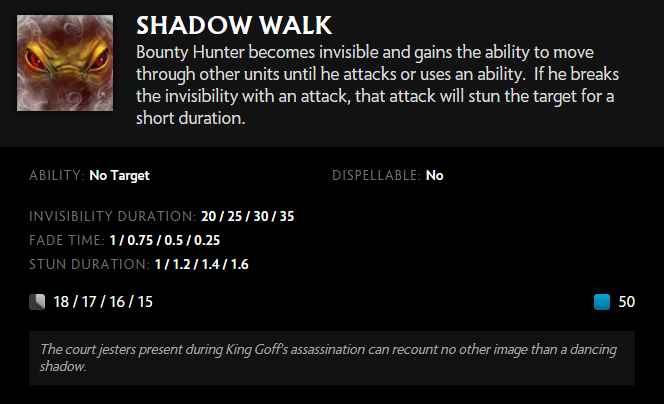
Bounty Hunter’s third ability – Shadow Walk – is what makes him the pesky hero that he is. The ability is simple: it grants Bounty Hunter invisibility, allowing him to roam around the map undetected. This ability allows him to scout enemy territory, gather information around the map, and set up ganks for his teammates.
Shadow Walk Ability Information (Image via Valve)
Shadow Walk becomes even more useful as Bounty Hunter stuns the target if he breaks the invisibility using an attack. So, it’s perfect for keeping enemies in place, or most importantly, canceling channels like Town Portal Scroll or other abilities.
After casting Shadow Walk, you can wait until the cooldown refreshes before attacking. That way, you can break your invisibility, stun the opponent, re-use Shadow Walk, and stun the opponent a second time.
In the early game, many Bounty Hunter players use this ability to go between towers and snipe enemy couriers.
Track (R)
Track is where all of Bounty Hunter’s abilities come together in unison – it’s his most iconic ability.
Track Ability Information (Image via Valve)
With this ability, Bounty Hunter “Tracks” an enemy, giving him full vision of them and their movements. It also continues revealing the enemies if they go invisible. Bounty Hunter and his allies gain damage amplification on Tracked enemies, too.
Though getting constant vision on enemies is nice, the main highlight is that, if a Tracked enemy dies, Bounty Hunter and nearby allies get bonus gold. Bounty Hunter himself gets up to 320 additional gold, while his allies receive 130.
The best part about Track is that it synergizes with Bounty Hunter’s other abilities. Shuriken Toss will bounce across all nearby Tracked heroes. Meaning if you Track three heroes, the shuriken will go through all of the targets, as long as they are within range. Additionally, Bounty Hunter doesn’t break Shadow Walk invisibility by casting Track.
With the bonus gold bounty in mind, many Bounty Hunter players want their teammates to consistently look for fights and pickoffs, as they can rake in lots of additional gold for every kill. This is the primary reason why Bounty Hunter is one of the strongest “snowball” heroes in the game.
Bounty Hunter’s Aghanim’s Upgrades
It’s worth taking a look at Bounty Hunter’s Aghanim’s Shard and Scepter upgrades, as one of the two is pretty decent.
Aghanim’s Shard
Bounty Hunter has a pretty useful Aghanim’s Shard, allowing him to grant his teammates Shadow Walk. Giving his teammates invisibility is one thing, but having the stun duration on attack is also extremely useful.
Aghanim’s Scepter
Unfortunately, Bounty Hunter doesn’t have the greatest Aghanim’s Scepter in the game in terms of power spikes and functionality. His Scepter upgrade allows him to increase Shuriken Toss’ cast range and apply a Jinada hit.
This isn’t too potent since Bounty Hunter doesn’t deal too much damage from Jinada when played as a support. However, it can be quite useful as a luxury item pickup, especially if fights last a long time. Note that since Jinada hits are also applied, Bounty Hunter also steals money from enemies every time a Shuriken connects.
Bounty Hunter Ability Build
Here is the most common support Bounty Hunter ability build:
Level
Ability
Talent
1
Shadow Walk
2
Shuriken Toss
3
Jinada
4
Shuriken Toss
5
Shuriken Toss
6
Track
7
Shuriken Toss
8
Jinada
9
Jinada
10
+0.6s Shuriken Toss Slow
11
Jinada
12
Track
13
Shadow Walk
14
Shadow Walk
15
-30% Damage Taken in Shadow Walk
16
Shadow Walk
17
Attributes
18
Track
19
Attributes
20
Track Grants Shared Vision
As a support Bounty Hunter, the most common build is to max Shuriken Toss first. Since Shadow Walk doesn’t provide too much value for every skill point, Jinada should be maxed out next.
Bounty Hunter Item Build
With how much additional gold Bounty Hunter can generate for his kills by killing enemy heroes, it’s clear that this hero prefers playing actively, wanting his team to go take fights and hunt down enemy heroes. An even trade in a Dota 2 teamfight or skirmish is almost always worth it for Bounty Hunter’s team, assuming he uses Track on all of the enemies.
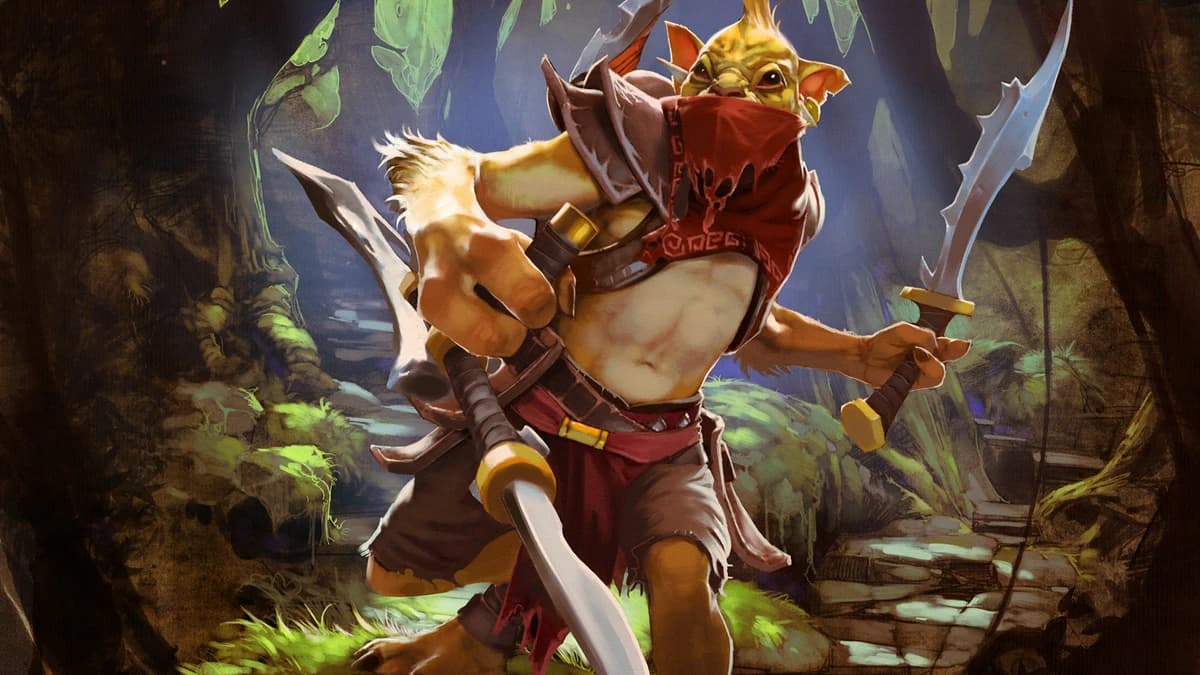
Bounty Hunter is usually tasked to buy team-oriented items (Image via Valve)
That being said, Bounty Hunter should purchase items that enable his teammates to get kills and keep the tempo going. That is why you will often see Bounty Hunter players buy aura or team-buffing items. Here are some of the best items on Bounty Hunter and why:
Urn of Shadows / Spirit Vessel
Since Bounty Hunter wants to participate in as many fights as possible, this idea works well with Urn of Shadows and the upgraded Spirit Vessel later on. Remember: you don’t need to deal any damage to get Urn charges from kills. Just being present is already enough. With Urn at hand, you can get bonus gold from Track as well as Soul Release charges for every kill.
Drums of Endurance
As mentioned earlier, Bounty Hunter wants to keep the kills rolling in. The best Dota 2 support players like buying Drums of Endurance, as it is a team-oriented item that can keep the entire team moving and continuing to look for kills. It also works well since most Bounty Hunter players go for Tranquil Boots – you can combine Tranquil Boots and Drums of Endurance to upgrade to Boots of Bearing.
Solar Crest
Bounty Hunter wants to secure kills with Track, but he doesn’t have the damage or capabilities to get these kills himself. So, he is heavily reliant on his team to dish out the damage, and Solar Crest helps his carries do so.
Pipe of Insight / Crimson Guard / Lotus Orb
Generally speaking, Bounty Hunter’s abilities don’t allow for much impact in teamfights, as he lacks damage and disables. So, the best way to contribute to the team is to use the high amount of gold he generates from Track and Jinada and pay it back to his team through utility Dota 2 items like Pipe, Crimson, or Lotus.
Scythe of Vyse / Wind Waker
When Track kills are consistently coming, you will find yourself with a lot of gold when playing as a Bounty Hunter. Oftentimes, you’ll have enough gold to purchase luxury items like Scythe of Vyse or Wind Waker. If your team needs more lockdown, go for Hex. If your team needs saves, Wind Waker is a viable option.
How to Properly Play Bounty Hunter [All Stages]
Here is how you should approach each stage of the game as a support Bounty Hunter:
Early Game
Being a melee hero, Bounty Hunter doesn’t have the strongest laning stage prowess. The best you can do is to secure ranged creep last hits using Shuriken Toss, and constantly hit the enemy players with Jinada to disrupt them and steal their gold. In impossible lanes, the best approach is to steal the enemy creep wave and drag it behind your Tier 1 tower.
Bounty Hunter can also snipe couriers using Shadow Walk, so planting an Observer Ward behind the enemy team’s tower can be a good way to contribute to the lane. Remember to help your mid-laner secure the Power Runes from minutes 6 to 10.
Mid Game
The mid-game is Bounty Hunter’s favorite time. This is when he wants to start getting the ball rolling. Try grouping up with your teammates and look to find pickoffs or take fights, and ensure you are Tracking enemies before killing them.
However, there will be moments where both teams want to farm, and the game is stale. In these situations, your job is to walk around the map under Shadow Walk and gather information. Find where their cores are farming, try interrupting enemy Smoke of Deceit ganks, and place deep Dota 2 Observer Wards in enemy territory.
When participating in a teamfight, remember that Bounty Hunter is not a frontliner, nor is he a right-clicker. You do not want to run headfirst into a teamfight – instead, play on the outskirts of the fight and continuously Track your opponents. Throw Shuriken Tosses here and there whenever you have multiple enemies Tracked, and play with an “in-and-out” style. Never hard commit – just keep kiting and find impact from afar.
Late Game
In the late game, Bounty Hunter’s spells do not deal much damage anymore. So, he makes up for the lack of teamfight impact by providing utility items for his teammates that help in the form of buffs, auras, or saves.
Again, there is almost no reason for you to run into the middle of a fight as a Bounty Hunter. Your job is to keep Tracking opponents and provide vision for the rest of the team.
If you are flowing in gold, you can invest in offensive items like Scythe of Vyse, Nullifier, or Bloodthorn to help your team lock down opponents or deal more damage.
Article Tags
No tags found
Tournaments
No tournaments found
Owen H
Dota 2 writer
Owen is as competitive as it gets, choosing to play the holy trinity of Dota 2, CS2 and Valorant with a primary focus on the former. He peaked at 8,500 MMR in Dota 2 and follows the professional scene religiously. You can still catch him as a regular on the Southeast Asian leaderboards.

















![How to REALLY Play Bounty Hunter in Dota 2 [Bounty Hunter Guide]](https://www.hotspawn.com/wp-content/uploads/2026/01/image_2026-01-04_033041128-1125x633.jpg)