How Rocket League ranks work – MMR ratings and skill distribution

Jack Marsh

Share:

With more ways to play Soccar than ever before, understanding how Rocket League ranks work is paramount to getting the most out of your sessions. With Ranked play being the most popular way to enjoy car football, the competitive playlists outweigh casual almost consistently.

How Rocket League ranks work – MMR ratings and skill distribution

But with hidden MMR ratings and a steep skill distribution bell curve to climb, getting to know the ins and outs of Ranked play will give you the best chance of getting to the top.

So, if you’re looking to take the first step on the competitive ladder, confused about how to get promoted, or want to know how to appear on the Top 100 Leaderboard, here’s exactly how Rocket League ranks work

How Rocket League Ranks Work

No matter how you like to play Rocket League, there is a Ranked playlist for everyone. From your bog-standard professional-replicating 3v3 Standard game mode to party modes like Hoops, anyone can put their skills to the test.

Each individual game mode has its own Ranked ladder, and to start your climb, each player must play ten ‘placement matches’. Depending on how you play against opponents of varying abilities the game generates a ‘MMR’ rating, which then correlates to what rank you earn.

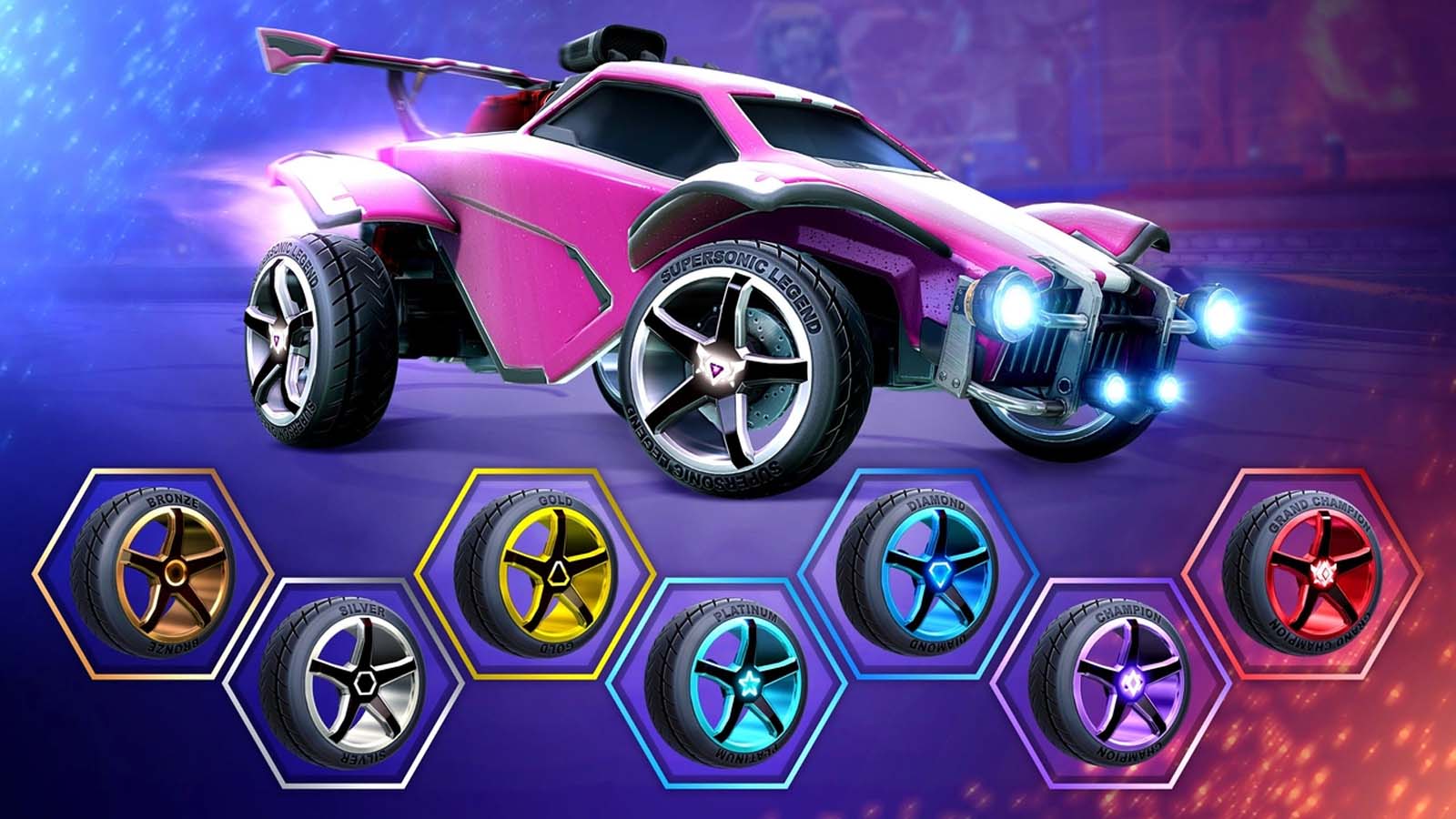
Ranks increase from Bronze to Supersonic Legend, but you can check out all Rocket League divisions here.

The Ranked ladder resets at the end of each Season, and players will earn rewards based on their peak rank if they have won enough games; the better the peak rank, the more advanced the reward is. Ranging from boosts and wheels to goal explosions and titles, the Seasonal rewards are plentiful and flex your skill level.

We unravel just how Rocket League ranks work, analysing the hidden MMR ratings and the skill distribution bell curve
Image Credit: Epic Games

Rocket League MMR Ranking

MMR (Matchmaking Rating) is a hidden mechanic in competitive gaming that works behind the scenes to generate a skill number, and Rocket League uses this in its ranked system.

In Soccar, MMR fluctuates with every win and loss a player gets in Ranked, and growing your rating is the only way to get promoted through the divisions. Typically, personal performance with goals, assists, saves, or triple flip resets doesn’t affect MMR (outside of 1v1 Duels), only during your placement matches, where overall points will help determine how far ahead or behind the opposition you are. It’s all measured by how well you can get the win.

MMR stats can only be tracked through third-party sites, as it remains a hidden feature in Rocket League, although it only really comes into play for those in the upper echelons of the skill distribution bell curve, trying to get into the Top 100 Leaderboards.

Rocket League Bell Curve – The Skill Distribution in Season 24

One of the final understandings you may need to know about how Rocket League ranks work is the bell curve – also known as skill distribution.

This measures where players sit on the ladder, where the ‘average’ player levels up to, and at what point of the grind do you begin to reap the rewards.

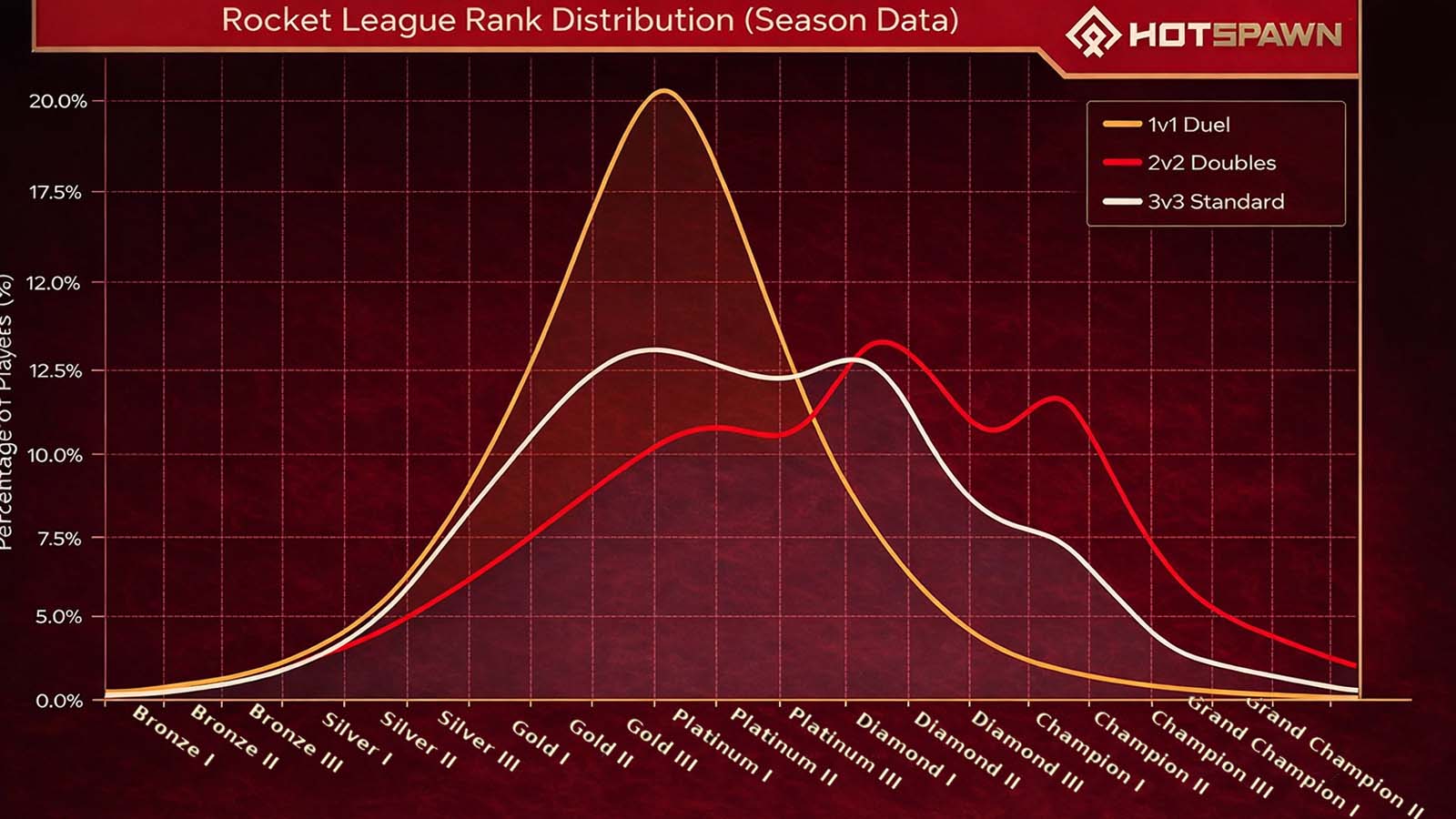
In Rocket League, this varies between each game mode. We’ve got you covered, though. As of Season 24, this is how the Rocket League bell curve looks.

We unravel just how Rocket League ranks work, analysing the hidden MMR ratings and the skill distribution bell curve
Image Credit: Hotspawn / Rocket League Tracker

In Solo play, most players group between Gold IV and Platinum I, with over 50 percent of players falling into this section. Only less than 15 percent of players move beyond Diamond II, which is indicative of how few people put raw mechanics to good use.

Over in Duos, though, teamwork with a friend goes a long way, and players find themselves much higher up the Rocket League bell curve. Most doubles end in Diamond II, although a second skill ceiling forms in Champion II, where only the elite 15 percent advance.

Typically, 3v3 Standard is the most spread and diverse spread of skill, with the same number of people populating Silver II as Champion I. As easy as it is to learn, getting past Champion is a luxury again in Trios, as every part of the ability pool needs to be combined, from team play to individual mechanics.

All in all, that’s exactly how Rocket League ranks work.

Article Tags

No tags found

Tournaments

No tournaments found
Jack Marsh

Jack Marsh

Author
Jack is six years into esports journalism, covering everything from Rocket League and VALORANT. While he is hard-stuck in Diamond in both, he’s a supersonic legend at unlocking the intrusive thoughts of your favourite professionals
More from Jack Marsh >